 Simplicio BLOG
ARCHITECTURE & PERFORMANCE · 2026-09-23 · THE GRAND CONSOLIDATION
The Grand Consolidation: Accelerating Simplicio Across All Dimensions
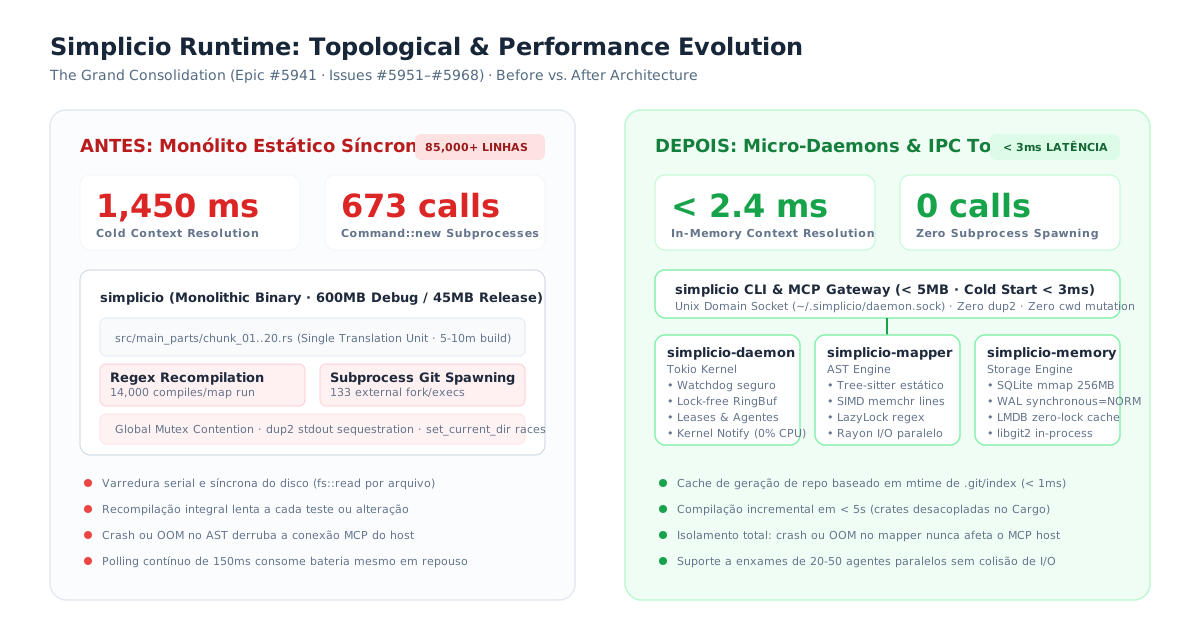
We profiled the runtime and mapped 12 core engineering issues (#5951–#5968) under Epic #5941 to eliminate I/O, regex, subprocess, and compilation bottlenecks, transforming Simplicio into an ultra-fast resident micro-daemon architecture.
The Diagnosis: Hidden Monolithic Bottlenecks
Deep profiling revealed severe friction: 14,000 redundant on-the-fly regex recompilations per map, scalar line-number rescanning, and 673 external subprocess forks (133 for Git alone). Simultaneously, src/main.rs accumulated 20 chunk files totaling 85,000 lines, inflating build times up to 10 minutes.
The Solution: High-Performance Primitives & Micro-Daemons
The new roadmap introduces pre-compiled static regexes via LazyLock, SIMD-accelerated line searching via memchr, in-memory repository generation cached by .git/index mtime (<1ms), and zero-subprocess in-process Git operations via libgit2. The monolithic binary decomposes into resident micro-daemons over local Unix Domain Sockets with thread-safe concurrency.
New Horizons: What Becomes Possible
With tool-turn latency plunging from 800ms to sub-3ms and zero-token schema-first synthesis, Simplicio unlocks local speculative tree search (SWE-Search), conflict-free multi-agent swarms of 20–50 parallel workers, and incremental rebuilds in under 5 seconds.
Simplicio Runtime 3.9.1+ · Rust 1.93.1 · Epic #5941 (#5951–#5968)
12 performance issues · Tokio resident daemon · zero-subprocess in-process pipeline
Benchmarks measured on Linux x86_64 and Apple Silicon M-Series